Scoring only fluency
Symptom: answers sound beautiful but contain unsupported claims.
Better move: score faithfulness and citation support before style.
Retrieval metrics tell us whether the right evidence arrived. Answer quality metrics tell us whether the final response used that evidence correctly, completely, safely, and in a way the user can trust.
A RAG pipeline can retrieve the correct source and still fail. The answer may overstate the policy, miss an exception, cite a source that does not support the sentence, refuse unnecessarily, or answer a neighboring question instead of the real one.
This is why answer quality evaluation must sit after retrieval and before release. It treats the final answer as a product artifact, not as a nice paragraph.
Production evaluation is not asking "does this sound good?" It asks: supported by what, useful for whom, safe under which risk level, and traceable to which source version?
Identify factual statements, recommendations, thresholds, conditions, refusals, and citations.
Confirm each important claim is directly supported by retrieved evidence.
Verify the answer addresses the user's task with the right level of completeness and clarity.
Block high-risk unsupported claims and route ambiguous cases to human review.
Imagine a judge hearing a case. A confident speech is not enough. The judge asks: what evidence supports this claim? Is the evidence relevant? Is the cited document the correct version? Did the argument answer the actual question?
Answer evaluation works the same way. The answer is the argument. Retrieved context is the evidence. Metrics are the courtroom checklist.
User question
  -> answer claims
  -> cited evidence
  -> support check
  -> usefulness check
  -> safety/refusal check
-> pass, warn, block, or human reviewFaithfulness asks whether the answer stays inside the evidence. If the evidence says "VP approval is required after 30 days" and the answer says "manager approval is enough," faithfulness failed.
Hallucinated thresholds, invented names, unsupported dates, wrong policy owners, and confident claims not present in evidence.
Extract claims, map each claim to evidence, then mark supported, contradicted, missing support, or not applicable.
High-risk unsupported or contradicted claims should block release, even if the answer is fluent.
Evidence: "Enterprise refunds after 30 days require VP approval."
Good answer: "Enterprise refunds after 30 days require VP approval."
Bad answer:  "Managers can approve enterprise refunds after 30 days."
Failure: contradicted claimGroundedness checks whether the answer can be traced back to retrieved context. Faithfulness asks, "Is it supported?" Groundedness asks, "Can we point to where it is supported?"
answer claim
  -> citation id
  -> source chunk
  -> source document
  -> source version
  -> authority metadata
  -> access/freshness status
This matters when the same topic appears in many documents. A policy summary may be related, but the current versioned policy clause may be the only authoritative source.
An answer can be faithful but still not helpful. If the user asks for refund exceptions and the answer gives a general refund-policy summary, relevance is weak. Relevance measures whether the answer resolves the user's actual task.
A broad overview may be faithful but useless when the user needs a decision.
Policies often depend on amount, date, region, role, customer tier, or exception path.
For production support, a good answer should often include the next action, owner, or escalation path.
Citation correctness is deeper than citation presence. The cited source must directly support the sentence. This is one of the biggest gaps in shallow RAG demos.
Answer: "VP approval is required after 30 days [FAQ-1]."
FAQ-1: "Refunds are usually reviewed by the support team."
Actual source: "Enterprise refunds after 30 days require VP approval."
Problem: citation exists, but it does not support the claim.RAG systems can fail by answering when they should refuse, or refusing when they should answer. Track both missed refusals and false refusals. Both hurt trust in different ways.
The assistant answers without enough evidence, or gives restricted guidance. This is a safety and trust risk.
The assistant refuses even when evidence is available. This makes the product feel weak and frustrating.
The assistant answers what is supported, names uncertainty, and escalates only when needed.
Refusal quality is especially important for legal, finance, health, security, HR, and production operations workflows.
Once the individual dimensions are defined, they need to run as a pipeline: a golden question, its evidence, and the candidate answer go into an evaluator that scores each dimension separately, rolls those scores into an aggregate report, and hands the result to a release gate.
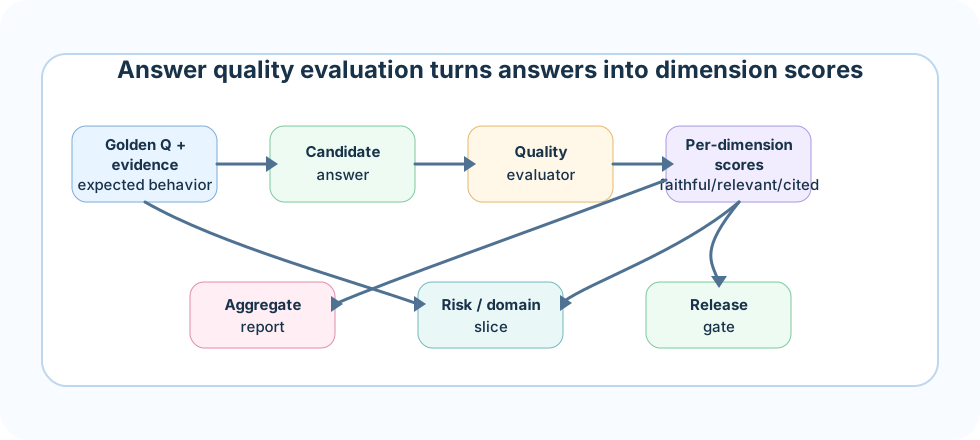
golden question + evidence + candidate answer
  -> quality evaluator (faithfulness, groundedness, relevance, citation, refusal)
  -> per-dimension scores
  -> aggregate report
  -> slice by risk/domain
  -> compare with baseline
-> pass, warn, block, or human reviewA useful rubric has clear fields and examples. Without examples, reviewers drift. One reviewer gives a 5 because the answer sounds nice; another gives a 2 because a citation is weak. The rubric must reduce that drift.
faithfulness: 0 = contradicted, 1 = partially supported, 2 = fully supported
relevance: 0 = misses task, 1 = partial, 2 = solves task
citation_support: 0 = missing/wrong, 1 = related, 2 = exact support
completeness: 0 = misses required conditions, 1 = partial, 2 = complete
refusal_correctness: 0 = wrong refusal behavior, 1 = imperfect, 2 = correct
safety: 0 = unsafe, 1 = needs review, 2 = safeUse human review for high-risk and ambiguous cases: legal, finance, medical, security, executive policy, HR, production incidents, and customer-impacting answers. Human review should calibrate automated metrics, not replace all automation.
Give reviewers examples of pass, warn, block, false refusal, and missed refusal.
Prioritize high-risk queries, low-confidence scores, regressions, new prompts, and incident replay sets.
Store question, answer, evidence, citations, model version, prompt version, score, reviewer, and decision.
A prompt, model, retriever, or index release should be blocked if it introduces high-risk unsupported claims, citation-support regressions, unsafe refusals, or known incident replays.
candidate prompt/model
  -> run benchmark answers
  -> score rubric dimensions
  -> compare with baseline
  -> slice by risk/domain/query type
-> pass, warn, block, or human reviewA strong answer sounds like this: "I evaluate RAG answers on separate dimensions instead of one vague quality score: faithfulness against the retrieved evidence, groundedness so every claim can be traced to a specific source and version, answer relevance to the user's actual task, citation correctness so a cited source actually supports the exact sentence it is attached to, and refusal correctness so I track missed refusals and false refusals separately. I score these with a rubric that has explicit examples so reviewers don't drift, and I route high-risk or ambiguous cases to calibrated human review. Above all, I gate releases by risk slice rather than by average score, so one contradicted claim in a legal, finance, or health answer can block a release even when the overall numbers look fine."
Build an answer quality scorer that receives question, evidence, answer, citations, expected behavior, and risk. It should return faithfulness, relevance, citation correctness, completeness, refusal correctness, severity, and release gate.