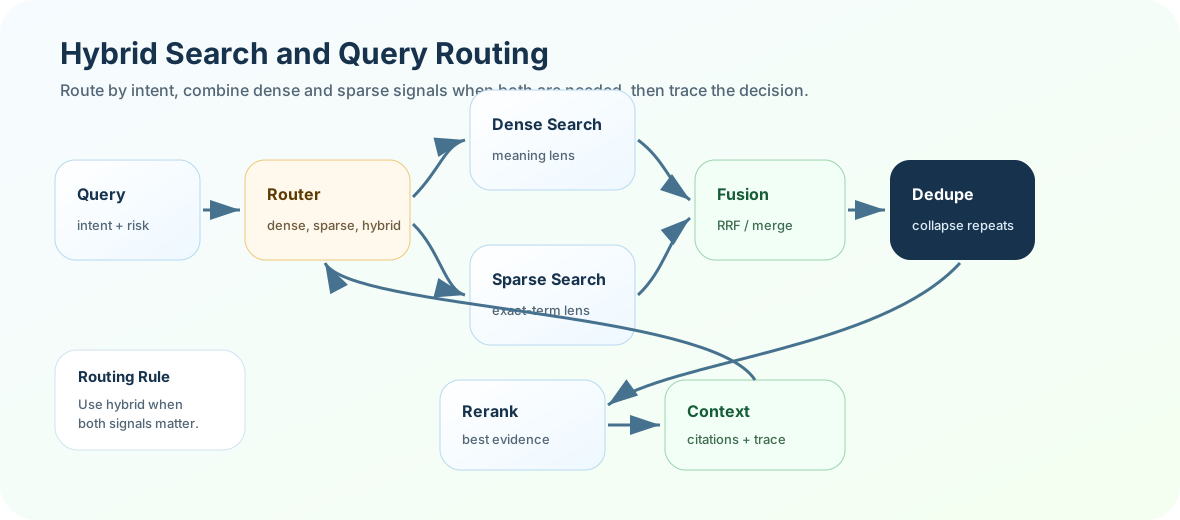
Hybrid search combines different retrieval signals, usually dense semantic search and sparse keyword search. Query routing decides which retrieval path to use for each question. Together, they help production RAG systems handle both natural language and exact operational facts.
How to read this chapter
Think complementary strengths: dense search understands meaning; sparse search protects exact terms like IDs, error codes, SKUs, and clause numbers.
Do not blend blindly: hybrid search needs fusion logic, score normalization, dedupe, and evals.
Route by intent and risk: a support paraphrase, legal clause lookup, and Sev1 runbook query should not always use the same retrieval path.
Trace every decision: production teams must explain why dense, sparse, hybrid, or fallback was chosen.
Dense retrieval may understand "regenerate credentials." Sparse retrieval may protect "ERR-AZ-4032-B." A production system often needs both.
Core ideaHybrid search combines multiple retrieval methods. Query routing chooses the right method based on intent, domain, exact-term need, risk, cost, and latency.
Sub-topic 1 of 14
Why Hybrid Matters
At a glance
Dense search is strong for meaning and paraphrase.
Sparse search is strong for exact terms and rare tokens.
Hybrid search can improve recall and precision when domains need both.
Routing prevents every query from paying every retrieval cost.
A user asks, "Why did deployment fail with AZ-4032-B after rotating the key?" Dense retrieval may understand key rotation. Sparse retrieval protects the exact error code. Hybrid retrieval can bring both signals together so the answer has the right troubleshooting evidence.
Hybrid retrieval north starUse the retrieval signal that matches the question, and combine signals only when the product needs it.
Hybrid is not automatically better. It is better when dense and sparse solve different parts of the same user need.
01
Detect exact-term need
Error codes, product IDs, SKUs, legal clauses, and ticket numbers often need sparse retrieval.
02
Detect semantic need
Paraphrases, vague questions, and natural-language support queries often need dense retrieval.
03
Choose route
Use dense, sparse, hybrid, graph, or fallback based on intent and risk.
04
Fuse and evaluate
Merge results, dedupe, rerank, and measure retrieval quality against golden queries.
Sub-topic 2 of 14
Real-Life Analogy: Two Lenses
Imagine reading a document with two lenses. One lens sees the overall meaning. The other lens highlights exact words and codes. If you only use the meaning lens, you may miss a specific policy number. If you only use the exact-word lens, you may miss a paraphrase.
Hybrid search uses both lenses when needed. Query routing decides whether one lens is enough or both should be used.
Mental picture
Dense search: meaning lens.
Sparse search: exact-term lens.
Fusion: merge both views.
Routing: choose the right lens for the question.
Sub-topic 3 of 14
Dense vs Sparse
Dense
Semantic vectors
Good for paraphrase, concept search, natural language, and meaning-based retrieval.
Sparse
Keyword signals
Good for IDs, codes, exact names, rare terms, legal clauses, and product identifiers.
Hybrid
Combined evidence
Good when the user question contains both semantic intent and exact operational facts.
Routing
Choose path
Good when every query should not pay every retrieval cost.
Sub-topic 4 of 14
BM25
BM25 is a classic sparse retrieval method. It scores documents based on query term matches, term rarity, and document length. You do not need to memorize the formula to use the mental model: rare matched terms matter more than common words.
Strong signal
AZ-4032-B, tenant_id, Policy 7.3, SKU-9910, and exact API names.
Weak signal
Vague paraphrases where user words do not appear in the document.
Production role
BM25 is often the sparse side of hybrid search and a useful fallback when dense retrieval misses exact terms.
Sub-topic 5 of 14
Fusion Strategies
Hybrid search must merge results from different retrievers. Dense scores and sparse scores may live on different scales, so simple score addition can be misleading.
Common fusion pattern
Reciprocal Rank Fusion
RRF combines rankings instead of raw scores. If a chunk ranks high in dense search and sparse search, it gets a stronger final rank. This is useful because raw dense and sparse scores are often not directly comparable.
Fusion flow
dense results:  A, C, D, F
sparse results: B, A, E, C

fusion:
  A appears high in both -> strong
  C appears in both      -> useful
  B sparse-only exact hit -> keep if exact term matters
  duplicates             -> collapse before context
Sub-topic 6 of 14
Query Routing
Query routing decides which retrieval path to use. A router can be rule-based, model-based, or hybrid.
Rule-based router
If query contains error code pattern, use sparse or hybrid. If query is natural language, use dense.
Model-based router
Classify intent with a lightweight model or LLM, then choose retrieval path.
Hybrid router
Use rules for obvious exact-term cases and a model for nuanced cases.
Mentor note: routing is a product behavior. Log the route decision so failures can be debugged.
Sub-topic 7 of 14
Risk-Based Routing
Some queries are high-risk: legal, HR, security, finance, medical, compliance, or operational incidents. These may need stricter filters, higher recall, reranking, citations, and refusal behavior.
Routing examples
Simple FAQ: dense search with low k may be enough.
Error code: sparse or hybrid retrieval protects the code.
Policy exception: hybrid plus reranking and parent expansion.
Symptom: cost and latency increase without measurable quality gain.
Better move: route only when hybrid is justified by intent or evals.
M06
Ignoring high-risk routing
Symptom: legal or security answers use weak evidence paths.
Better move: enforce stricter filters, citations, and reranking for high-risk domains.
M07
No exact-term eval slice
Symptom: aggregate recall looks fine while code/SKU queries fail.
Better move: split evals by exact-term, paraphrase, domain, and risk.
M08
Forgetting dedupe after fusion
Symptom: same chunk appears through dense and sparse paths and wastes context.
Better move: dedupe by chunk id, source id, parent id, or content hash.
Sub-topic 12 of 14
Interview-Level Understanding
A strong answer sounds like this: "Hybrid search combines dense semantic retrieval with sparse lexical retrieval. It is useful when queries need both paraphrase understanding and exact-term protection. I route queries by intent and risk, fuse results with calibrated or rank-based methods, dedupe, rerank, and evaluate route-specific Recall@k, exact-term recall, latency, and citation support."
Senior signal
What production reviewers want
Explain when not to use hybrid too. Good architecture avoids unnecessary cost and complexity when dense or sparse alone is enough.
Sub-topic 13 of 14
Mini Assignment
Create a routing policy for five query types: simple FAQ, error code, legal clause, policy exception, and incident runbook. Define retrieval route, filters, fusion method, top-k, reranking need, and metrics.
Sub-topic 14 of 14
Points To Remember
Dense retrieval is strong for meaning; sparse retrieval is strong for exact terms.
Hybrid search combines signals when a query needs both.
Query routing avoids unnecessary cost and chooses the right retrieval path.
Fusion must handle different score scales and duplicates.
Production hybrid retrieval needs route traces and route-specific evals.
Next, test hybrid routing judgment in the quiz, then build a query router in exercises and project.