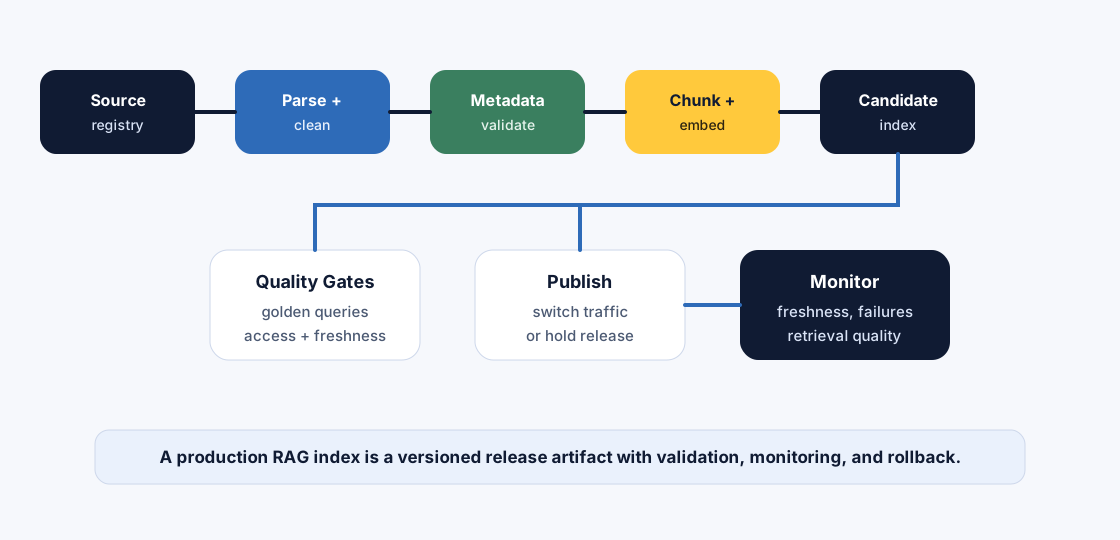
A production RAG system needs a repeatable way to move approved sources into searchable indexes. Ingestion and indexing pipelines turn source governance, parsing, cleaning, metadata, chunking, embedding, validation, and publishing into an operated system.
How to read this chapter
Read it as release engineering for knowledge: an index is not a random database dump; it is a versioned artifact that can pass gates, publish, roll back, and be monitored.
Separate batch and incremental ingestion: first builds and daily updates need different controls.
Track every run: pipeline logs, run ids, source counts, failure reasons, index versions, and quality metrics are production essentials.
Design for recovery: retries, dead-letter queues, quarantine lanes, rollback, and re-indexing are not advanced extras. They are how real systems survive messy data.
If Chapter 5 chose the sources, Chapter 6 prepared the text, and Chapter 7 designed the metadata, Chapter 8 asks the production question: how do we run this safely again and again?
Core ideaAn ingestion pipeline is the controlled journey from approved source to published searchable index. An indexing pipeline creates the retrieval artifact that online RAG will search.
Sub-topic 1 of 11
Why Ingestion Pipelines Matter
At a glance
Production corpora change: policies update, pages move, PDFs break, schemas drift, and permissions change.
A pipeline makes ingestion repeatable, observable, recoverable, and safe to release.
Index versions should be treated like software releases, with validation and rollback.
Why this matters: many RAG demos work once because someone manually curated documents. Production RAG must work every day as documents change, teams add sources, and users depend on current answers.
An ingestion pipeline gives the team a controlled path: discover changed sources, validate approval, parse, clean, attach metadata, chunk, embed, validate retrieval behavior, publish a new index version, and monitor the result.
Pipeline north starNever publish knowledge you cannot trace, validate, monitor, or roll back.
A good pipeline does not just produce vectors. It produces a reliable, explainable index artifact that the online RAG system can trust.
Parse, clean, preserve structure, validate metadata, chunk, embed, and keep lineage at every stage.
03
Can we validate the new index?
Run golden queries, metadata completeness checks, freshness checks, retrieval recall tests, and access-control tests.
04
Can we recover if it fails?
Use retries, quarantine, dead-letter records, rollback, old index retention, and human review lanes.
Sub-topic 2 of 11
Real-Life Analogy: A Factory Assembly Line
A factory does not build a product by throwing parts into a room and hoping a finished item appears. It has stations: intake, inspection, assembly, quality control, packaging, release, and support.
A RAG ingestion pipeline is the same. Sources move through stations. Each station has a contract. If a station fails, the item is repaired, quarantined, rejected, or retried. That is how knowledge becomes reliable enough for users.
Quick recap
Ingestion is the manufacturing line for knowledge.
Indexing creates the searchable release artifact.
Quality gates protect the online assistant.
Sub-topic 3 of 11
Technical Explanation: Pipeline Stages
Text diagram: production ingestion flow
source registry
  -> change detection
  -> approval and access checks
  -> parsing and cleaning
  -> metadata validation
  -> chunking
  -> embedding
  -> index write
  -> quality gates
  -> publish index version
  -> monitor online behavior
Input contract
Every run should know source ids, source versions, owners, access labels, changed files, ingestion reason, and expected output index version.
Output contract
The pipeline should produce chunk records, embeddings, metadata, index version, validation report, failed records, and publish decision.
Failure contract
Every failure should have a stage, source id, error class, retryability, owner, and next action.
Mentor note: do not think "run a script to embed files." Think "ship a knowledge release with checks, logs, and rollback."
Sub-topic 4 of 11
Batch Ingestion vs Incremental Updates
Not all ingestion runs are the same. A first build, nightly sync, urgent policy fix, and full re-index have different risk profiles.
Batch ingestion
Build or rebuild a whole corpus
Useful for first launch, major schema changes, embedding model changes, or full quality resets. It is slower but easier to validate as a full release.
Incremental ingestion
Update only changed sources
Useful for daily updates, small source changes, and lower-cost freshness. It needs careful delete/update logic so stale chunks do not survive.
Hotfix ingestion
Patch urgent knowledge quickly
Useful when a policy or runbook must be fixed immediately. It needs strict approval and post-release validation.
Re-indexing
Regenerate retrieval artifacts
Needed when chunking, metadata schema, embedding model, parser, or vector-store settings change.
Production case study
New refund policy published at midnight
The support assistant must stop using yesterday's policy and start using the new approved policy.
Change detection: identify the new source version and retired old version.
Incremental update: parse, clean, metadata-validate, chunk, embed only affected documents.
Freshness gate: golden refund questions must retrieve the new version.
Rollback: if the index fails validation, keep serving the previous known-good index and escalate.
Sub-topic 5 of 11
Indexing and Re-Indexing Strategy
Indexing writes chunks, embeddings, and metadata into a retrieval system. Re-indexing rebuilds those artifacts when something upstream changes.
When to re-index
Re-index when:
  parser output changes
  cleaning rules change
  chunking strategy changes
  metadata schema changes
  embedding model changes
  vector-store index settings change
  source authority or access labels change
Production failure mode
A team updates metadata rules but does not re-index old chunks. The online system now has a mixed index where old and new records behave differently.
Engineering checklist
Version parser, cleaner, chunker, embedding model, metadata schema, and index config.
Keep blue/green or previous-index rollback.
Run golden retrieval tests before publish.
Metrics to watch
index publish success rate, golden query pass rate, stale chunk count, failed source count, embedding cost, and p95 indexing duration.
Sub-topic 6 of 11
Pipeline Logs and Failure Recovery
Ingestion logs should answer: what ran, what changed, what passed, what failed, what was published, and what must be fixed next.
Run representative questions after every index build to catch missing sources, stale sources, bad chunking, or broken metadata filters.
Consistency
Idempotency protects repeatability
A failed run should be safely repeatable without duplicate chunks, mixed versions, or partial publish states.
Scale
Incremental updates protect cost
Only changed sources should be re-parsed, re-chunked, re-embedded, and re-indexed unless a full rebuild is required.
Safety
Access tests must run before publish
A new index should prove that restricted content is filtered correctly for different user roles.
Sub-topic 9 of 11
Common Mistakes
Pipeline mistakes usually appear later as stale answers, missing citations, duplicate chunks, expensive runs, or retrieval regressions.
M01
Embedding files directly without pipeline gates
Symptom: bad documents enter the index because no source, parser, or metadata validation ran.
Better move: enforce source, parser, metadata, chunking, and retrieval gates before publish.
M02
No index versioning
Symptom: teams cannot explain which index produced a bad answer.
Better move: stamp every index with version, run id, schema version, and embedding model.
M03
Incremental updates leave stale chunks behind
Symptom: old policy chunks still answer after a new version is published.
Better move: handle deletes, replacements, retired sources, and parent-document version changes explicitly.
M04
No rollback path
Symptom: a bad index ships and the team has to repair live traffic manually.
Better move: keep previous known-good indexes and practice rollback.
M05
Ignoring failed records
Symptom: ingestion shows "mostly successful" while critical documents are missing.
Better move: track failed source count, failed source priority, owner, and next action.
M06
Publishing without golden query tests
Symptom: the index is technically built but retrieves the wrong evidence.
Better move: run golden retrieval, citation, freshness, and access-control tests before publish.
M07
Re-indexing everything for every small change
Symptom: costs explode and freshness slows down.
Better move: use change detection and dependency-aware re-indexing.
M08
Not recording pipeline lineage
Symptom: nobody knows which parser, cleaner, chunker, or embedding model created a chunk.
Better move: store run id, stage versions, and source lineage on every record.
M09
No dead-letter lane
Symptom: repeatedly failing documents disappear into logs.
Better move: create owner-visible failure queues with stage, reason, and retry state.
M10
Monitoring only online answers
Symptom: ingestion quality degrades for days before users notice answer failures.
Better move: monitor pipeline quality, freshness, failures, source coverage, and golden query pass rate.
Sub-topic 10 of 11
Mini Assignment
Design an ingestion pipeline for one domain: HR policy, customer support, security runbooks, developer docs, or finance. Include stages, quality gates, run logs, retry rules, dead-letter behavior, publish criteria, and rollback plan.
Sub-topic 11 of 11
Points To Remember
Ingestion turns approved sources into retrieval-ready records.
Indexing produces a versioned searchable artifact.
Batch, incremental, hotfix, and re-indexing runs need different controls.
Pipeline logs, quality gates, retries, quarantine, dead-letter queues, and rollback are production requirements.
A RAG index should be released with the same seriousness as application code.
Next, test pipeline judgment in the quiz, then build an ingestion run auditor in the exercises and project.