RAG for Everyone

← Back to all chapters

Chapter 6 of 28Ingestion55 min read

Parsing and Cleaning

Parsing and cleaning are where raw documents become usable knowledge. Before chunking, embeddings, retrieval, or prompting can work well, the system must extract text correctly, remove noise safely, preserve structure, and prove that the cleaned output is trustworthy.

How to read this chapter

A RAG system may look intelligent at the answer layer, but it often fails because the parser quietly broke a table, removed a heading, duplicated a footer, or mixed an old policy with a current one.
Core ideaParsing extracts usable content from a source. Cleaning removes noise and normalizes content. Production RAG needs both, but it must never clean away the meaning that retrieval needs later.
Sub-topic 1 of 11

Why Parsing and Cleaning Matter

At a glance
  • Parsing turns files, pages, records, and media into structured text and metadata.
  • Cleaning removes repeated, irrelevant, corrupted, or unsafe content before chunking.
  • Bad parsing creates retrieval failures that look like model failures later.
Why this matters: if a PDF parser reads a table column in the wrong order, the model may confidently answer with the wrong price, policy limit, date, or approval owner. The model did not invent the error. The ingestion pipeline handed it broken evidence.

Parsing and cleaning sit between source selection and chunking. Chapter 5 taught us which sources deserve to enter the corpus. Chapter 6 asks: once a source is approved, how do we extract it safely?

This step is easy to underestimate because it is not glamorous. But in production systems, parsing quality shapes everything after it: chunk quality, embedding quality, retrieval quality, citation quality, and evaluation quality.

Parser north starClean the noise, preserve the meaning, and make every transformation auditable.

A parser should never be a silent black box. It should explain what it extracted, what it removed, what it could not understand, and whether the result is safe for indexing.

01
Can we read the source correctly?

Detect format, encoding, layout, OCR needs, tables, images, and source-specific extraction rules.

02
Can we preserve structure?

Keep heading paths, page numbers, section ids, table coordinates, row ids, timestamps, and source links.

03
Can we remove noise safely?

Remove navigation, boilerplate, repeated headers, broken characters, empty sections, and duplicate blocks without deleting policy meaning.

04
Can we prove readiness?

Return quality score, warnings, rejected reasons, sample snippets, and metrics before publishing to the index.

Sub-topic 2 of 11

Real-Life Analogy: A Chef Preparing Ingredients

Imagine a chef preparing vegetables for a busy restaurant. Washing removes dirt. Peeling removes unwanted skin. Cutting makes the pieces usable. But if the chef accidentally throws away the edible part and keeps the peel, the final dish fails before cooking begins.

Parsing and cleaning work the same way. We remove noise, but we preserve the nutritious part: headings, clauses, page numbers, table labels, effective dates, source ids, and relationship clues.

Quick recap
  • Parsing is extraction.
  • Cleaning is controlled preparation.
  • Quality gates decide whether content is ready for chunking.
Sub-topic 3 of 11

Technical Explanation: The Parsing Pipeline

A production parser does more than read text. It classifies, extracts, normalizes, validates, and reports.

Text diagram: parsing to cleaning flow

Approved source
  -> format detection
  -> parser selection
  -> raw extraction
  -> structure preservation
  -> noise removal
  -> normalization
  -> quality checks
  -> parsed document contract
  -> ready for chunking or rejected for review

Raw extraction

Pull text, tables, metadata, links, page numbers, object ids, headings, and media references out of the original source.

Cleaning

Remove repeated layout text, invalid characters, cookie banners, navigation, duplicate sections, empty blocks, and corrupted OCR artifacts.

Validation

Check whether required fields exist, extraction confidence is high enough, and the content has enough structure to become useful chunks.

Mentor note: do not think of parsing as "convert PDF to text." Think of it as "convert a source into an evidence object that retrieval can trust."
Sub-topic 4 of 11

Format-Specific Parsing Risks

Each format breaks in its own way. A strong ingestion pipeline uses format-aware parsers and format-aware quality checks.

PDF

PDF parsing

What exactly it is: extracting text, tables, page structure, and images from layout-heavy files.
Risk: reading order, columns, footnotes, scanned pages, and tables can become scrambled.
Production control: capture page number, section title, OCR confidence, table boundaries, and extraction warnings.
HTML

HTML parsing

What exactly it is: extracting the main content from web pages while ignoring layout and navigation.
Risk: cookie banners, menus, sidebars, duplicate links, and hidden content pollute chunks.
Production control: keep canonical URL, heading hierarchy, crawl timestamp, and main-content extraction score.
DOCX

DOCX parsing

What exactly it is: extracting paragraphs, tables, comments, revisions, and embedded objects from office documents.
Risk: tracked changes and comments may be mistakenly treated as approved policy.
Production control: decide whether comments, revisions, and draft marks are included, excluded, or quarantined.
CSV

CSV parsing

What exactly it is: reading rows and columns while preserving schema meaning.
Risk: values lose units, column descriptions, row identity, or join meaning when converted to plain text.
Production control: attach schema, units, row ids, column descriptions, and source table name.
JSON

JSON parsing

What exactly it is: flattening or preserving nested objects for retrieval.
Risk: parent-child relationships disappear when nested objects are flattened carelessly.
Production control: preserve key paths, object ids, parent ids, arrays, and relationship labels.
OCR

OCR parsing

What exactly it is: extracting text from images, scanned PDFs, screenshots, and forms.
Risk: low-confidence characters change numbers, dates, names, and policy limits.
Production control: store confidence, bounding boxes, page regions, and route low-confidence pages to review.
Sub-topic 5 of 11

Cleaning Strategy: Remove Noise Without Removing Meaning

Cleaning should be conservative. The goal is not to make text pretty. The goal is to make evidence reliable.

Boilerplate

Remove repeated layout text

Headers, footers, menus, page numbers, copyright blocks, cookie banners, and navigation can dominate retrieval if repeated across many chunks.

Normalization

Make equivalent text comparable

Normalize whitespace, encoding, bullet symbols, line breaks, and repeated punctuation so retrieval sees stable text instead of formatting noise.

Deduplication

Reduce repeated evidence

Duplicate pages, copied policy sections, and mirrored web pages can make the same evidence appear artificially important.

Preservation

Keep retrieval-critical clues

Effective dates, section headings, table labels, exceptions, warning notes, source owners, and access labels must survive cleaning.

Production case study

Cleaning a refund policy PDF

A refund policy PDF has a repeated footer, a version watermark, a two-column table, and an exception note in small text.

  • Safe to remove: repeated footer, page decoration, duplicated navigation text.
  • Must preserve: policy version, country column, refund window, exception note, approval owner, and page number.
  • Needs warning: if table extraction confidence is low, the source should not silently enter the index.

The lesson: cleaning is not deletion. It is controlled evidence preparation.

Sub-topic 6 of 11

Parser Contracts

A parser contract defines what every parser must return. This keeps ingestion reliable even when source formats differ.

Example parser output contract

{
  "source_id": "refund_policy_2026_pdf",
  "format": "pdf",
  "text_blocks": [...],
  "tables": [...],
  "metadata": {
    "owner": "Support Ops",
    "version": "2026.2",
    "access": "internal",
    "page_count": 18
  },
  "structure": {
    "heading_path": ["Refunds", "EU annual plans"],
    "page_numbers": [4, 5]
  },
  "quality": {
    "parse_score": 0.91,
    "warnings": ["table_2_low_confidence"],
    "ready_for_chunking": false
  }
}

Required fields

  • source id, format, owner, version, access level
  • text blocks with source positions
  • warnings and quality score

Optional but powerful

  • tables, bounding boxes, key-value pairs
  • image captions, links, anchors
  • detected language and section hierarchy

Failure states

ready, ready_with_warnings, needs_review, rejected, or parser_not_supported. Never hide parser uncertainty.

Sub-topic 7 of 11

Architecture View

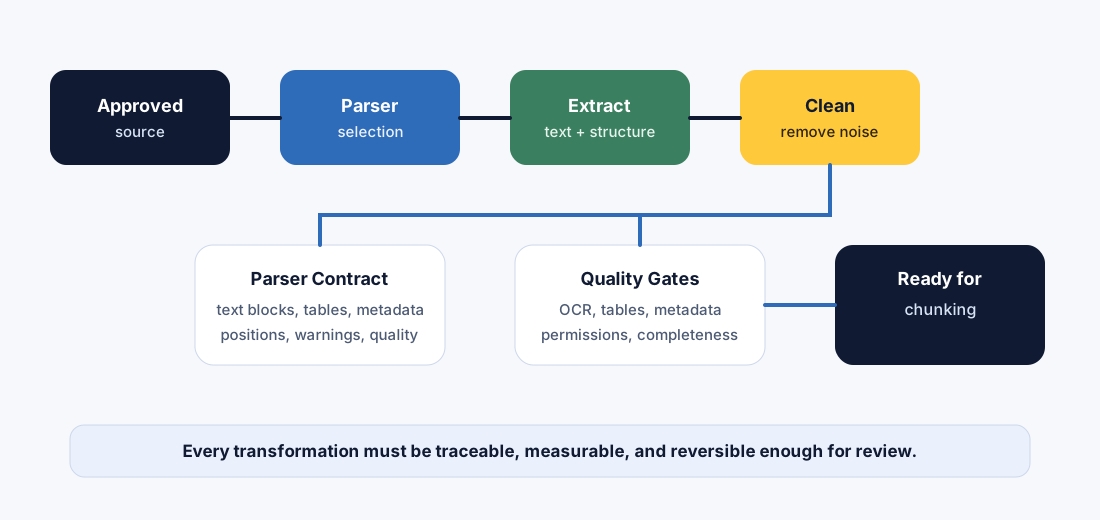
Parsing and cleaning architecture showing source, parser selection, extraction, cleaning, quality gates, and chunking readiness
Parsing and cleaning sit between approved sources and chunking. Quality gates decide whether content can safely enter the retrieval pipeline.

Quality gate ladder

Parsed successfully?
  -> structure preserved?
  -> required metadata present?
  -> noise below threshold?
  -> tables/OCR acceptable?
  -> permissions carried forward?
  -> ready for chunking
Sub-topic 8 of 11

Production Controls

Production gear
  • Parser registry: map source formats to approved parsers, owners, versions, and known limitations.
  • Quality thresholds: reject or review documents with low OCR confidence, missing metadata, broken tables, or empty extraction.
  • Golden files: keep known PDFs, HTML pages, CSVs, and DOCX files to regression test parser changes.
  • Diff review: compare parser output before and after parser upgrades.
  • Audit logs: record parser version, extraction time, warnings, and cleaning rules applied.
  • Human review lane: route high-risk, low-confidence, or unsupported formats to review before indexing.
Accuracy

Measure extraction, not only answers

Track table extraction accuracy, OCR confidence, heading preservation, source-position coverage, and text-block completeness.

Consistency

Parser upgrades can change retrieval

A better parser may produce different chunks, embeddings, and search results. Treat parser upgrades like product releases.

Scale

Batch parsing needs backpressure

Large corpora need queues, retries, dead-letter records, file-size limits, and clear handling for slow or failed documents.

Security

Cleaning must preserve access labels

Never strip permissions, tenant ids, source authority, or sensitivity labels during normalization.

Sub-topic 9 of 11

Common Mistakes

Parsing mistakes are painful because they happen early and appear later as retrieval, citation, or answer failures.

M01

Using one parser for every format

Symptom: PDFs, HTML pages, tables, and DOCX files all become weak plain text.
Better move: create format-specific parsers and quality checks.
M02

Removing headings during cleaning

Symptom: chunks lose the section context needed for retrieval and citations.
Better move: preserve heading paths as metadata and optionally prepend them to chunks.
M03

Trusting OCR without confidence gates

Symptom: dates, limits, names, and IDs are misread but still indexed.
Better move: store OCR confidence and route low-confidence regions to review.
M04

Flattening tables into unreadable text

Symptom: column meaning disappears and the assistant answers with wrong values.
Better move: preserve table structure, headers, units, row ids, and page references.
M05

Deleting "small" exception notes

Symptom: the main rule is indexed but exceptions are lost.
Better move: treat exceptions, warnings, footnotes, and legal notes as high-value evidence.
M06

Deduplicating too aggressively

Symptom: similar but legally different policy versions collapse into one record.
Better move: dedupe by source identity, version, section, and authority, not only text similarity.
M07

Losing source positions

Symptom: citations point to documents but not pages, rows, sections, or regions.
Better move: carry page number, row id, heading, URL anchor, timestamp, or bounding box through the pipeline.
M08

Publishing parser warnings into the index

Symptom: known-bad extraction still enters retrieval because warnings are ignored.
Better move: make warnings actionable: ready, needs review, rejected, or parser unsupported.
M09

Cleaning away access and sensitivity labels

Symptom: retrieval cannot enforce permissions after content is normalized.
Better move: treat security metadata as non-removable fields.
M10

Skipping parser regression tests

Symptom: a parser library upgrade changes extraction behavior and silently breaks retrieval.
Better move: keep golden files and compare extracted blocks, tables, metadata, and quality scores before release.
Sub-topic 10 of 11

Mini Assignment

Choose one source from your domain: a PDF policy, an HTML docs page, a DOCX runbook, a CSV pricing table, or a JSON API response. Write the parser contract for it. Include required metadata, cleaning rules, quality gates, warnings, and the condition that would reject it from indexing.

Sub-topic 11 of 11

Points To Remember

  • Parsing extracts usable evidence from approved sources.
  • Cleaning removes noise but must preserve meaning.
  • Format-specific risks require format-specific quality checks.
  • Parser contracts should include text, structure, metadata, warnings, quality, and readiness.
  • Parser changes can change retrieval behavior, so they need regression tests and release gates.

Next, test parsing and cleaning judgment in the quiz, then build a parser quality gate in exercises and the project.

← Chapter 5 ProjectTake the Quiz →